Family archivists
An old scan looks soft after years of copying or low-resolution storage.
A clearer version can make faces, objects, and edges easier to inspect while preserving the original as a reference.
unblur image online freeClarity explained
What is unblur image online? It is the process of improving a soft, hazy, or motion-affected picture so important details appear clearer. The result can be more readable and useful, but it is an enhancement rather than a perfect reconstruction of missing information.
Supavisual has 2×/4× upscale and background removal, but no dedicated unblur, deblur, or sharpen tool. Upscaling cannot reliably recover lost text or detail. This link opens its home page; sign-in and a paid AI plan are required. Any paired images here are illustrations of concepts, not verified processing results from this site or Supavisual.

Related guides
These focused guides explain nearby ways people approach unclear photos, from phone images to text and dedicated enhancement tools.
See how artificial intelligence can estimate and restore details in a soft photograph.
Compare the practical considerations before choosing an online route for image enhancement.
Learn which traditional adjustments can improve clarity without relying on an AI model.
Find out why tiny or blurred lettering is especially difficult to recover accurately.
Real-world uses
The same basic process serves different goals: checking a visual clue, preparing an image for presentation, or making an old file easier to use.
An old scan looks soft after years of copying or low-resolution storage.
A clearer version can make faces, objects, and edges easier to inspect while preserving the original as a reference.
unblur image online freeA product photo is usable but lacks crisp edges for a listing or social post.
Enhancement can improve presentation without requiring a full reshoot when the underlying details are already present.
unblur image free enhancerA screenshot, scan, or photographed page contains visual details that are difficult to inspect.
Improved contrast and sharpness may make the material easier to review, though uncertain text still needs verification.
unblur image textA handheld shot has mild movement or focus softness that was noticed after capture.
A browser-based workflow can provide a convenient first attempt before deciding whether the photo should be retaken.
unblur image for iphoneThe basic workflow
Most enhancement workflows follow three practical stages. Each stage affects how much useful detail can be recovered and how natural the final image looks.
Identify the dominant problem: focus softness, camera shake, compression, low resolution, or a combination. The original file usually gives the best starting point.
The tool strengthens edges, balances local contrast, reduces distracting noise, and may estimate plausible detail where the source is incomplete.
Compare the result at a useful viewing size. Keep the enhanced copy separate so you can check whether a sharper edge represents real information or an invented pattern.
Site context
These figures describe the site context rather than a promise about the result of any individual enhancement.
Set expectations
The quality of the starting file determines how much an enhancement can confidently improve. This comparison separates visible information from information that has already been lost.
Clear source image
Edges are already defined and need little correction.
Blurred source image
Edges spread into nearby pixels and may need estimation.
Clear source image
Characters can often be inspected at a practical zoom.
Blurred source image
Letters may merge together, making exact recovery uncertain.
Clear source image
Surface detail is recorded in the original file.
Blurred source image
Texture may be softened, compressed, or replaced by noise.
Clear source image
Objects retain a stable outline.
Blurred source image
Movement can create directional streaks that are difficult to reverse.
Clear source image
Color boundaries are easier to distinguish.
Blurred source image
Blur can mix neighboring colors and weaken separation.
Clear source image
Enhancement mainly polishes an existing signal.
Blurred source image
Enhancement may improve appearance without restoring every true detail.
Important limits
A useful explanation includes the boundaries. Enhancement can make an image easier to view, but it cannot reliably recreate every detail that the camera never captured.
If a face, letter, or object was never recorded clearly, software has no dependable source from which to reproduce it.
WorkaroundUse the result as a visual aid, not as proof of an uncertain detail.
Blurred characters can overlap until several letters look alike, especially in small screenshots or compressed photos.
WorkaroundCheck the original document or request a sharper scan whenever accuracy matters.
Severe camera movement can spread information across multiple directions and leave too little signal for a natural correction.
WorkaroundRetake the image with steadier support, better light, or a faster shutter when possible.
An enhanced copy may look cleaner while still containing processing artifacts, halos, or invented-looking texture.
WorkaroundKeep the untouched original and compare both versions before sharing or making decisions.
Visual example
The before-and-after pattern is easiest to judge when both versions remain visible. Look for improved edges and readability, not details that appear only because processing made them plausible.

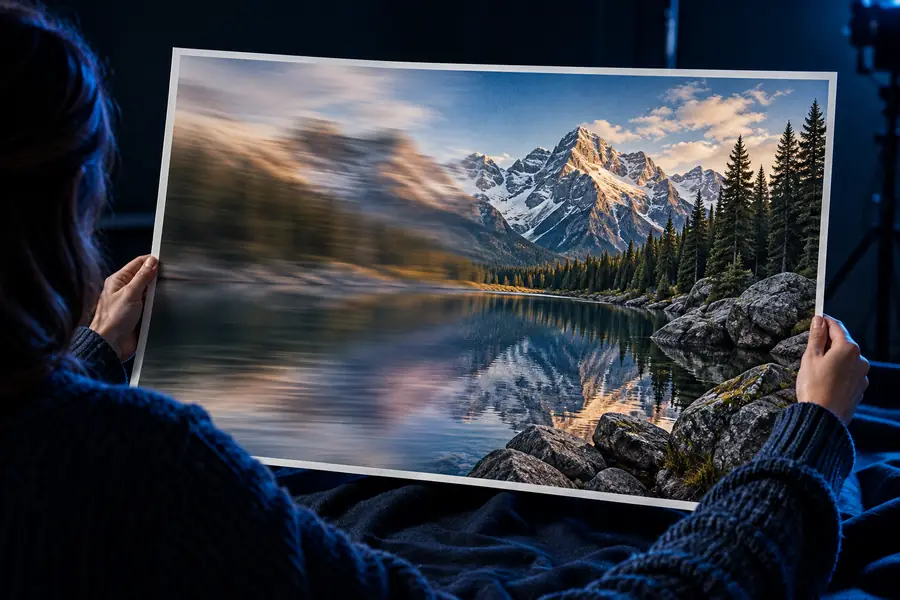
A clearer appearance is not the same as recovered truth.
Ready to inspect
Once you know what the process can and cannot do, you can judge an enhanced result more responsibly. Keep the original, use a clear comparison, and treat uncertain details as uncertain.
Common questions
Here are the essential answers for anyone researching what this type of online image enhancement means.
It is an online process for improving the apparent clarity of a soft, noisy, compressed, or slightly blurred image. A tool may sharpen edges, reduce noise, adjust contrast, or estimate plausible detail, but the result is still an enhancement rather than a guaranteed recovery of the original scene.
No. Mild softness may improve noticeably, while severe focus loss, strong motion blur, tiny text, or missing pixels can remain difficult or impossible to correct accurately. Always compare the processed image with the original and treat uncertain details cautiously.
It can make a low-quality image look cleaner and sometimes enlarge it, but enlargement does not automatically create genuine camera detail. The final image may be more useful for viewing while still being unsuitable as an exact record of information that was never captured.
Not by itself. Processing can introduce halos, artificial texture, or plausible-looking details, so an enhanced image should support inspection rather than replace the original, a better source file, or independent verification.